On coloring pages
and the process of "returning to joy."

In my last post I mentioned my plan to begin sharing some tools I’ve picked up in my close-to-half-century span on this earth (doesn’t that sound lofty and impressive?). Instead of waiting to create an offshoot of Come & Ponder (another publication/a different stream of thought) I’m going to keep it in this flow. Water passes too quickly under the bridge of my intention and as mentors of mine have sad: anything worth doing is worth doing poorly.1 So, here’s a start: I hope it helps plant seeds of encouragement.
My essays are for the average Joe or Jane, like myself. For the busy dad or mom, swamped with life’s pressures. My posts are for anyone who, like me, may have lost sight of what it’s all about. Maybe you’re finding yourself in the dead center of life, experiencing the “deadness” that goes with it. There is so much traffic at this intersection: kids, marriage, job, friends, home and lawn maintenance, aging parents, bills, volunteering at church (or elsewhere), exercise/self-care. We look around, but it seems like we are the “traffic cop” in this scenario, and no one’s listening to our whistle. If this feels like you, I hope this offering helps you to pause and find your way back to you.2
Slowing down to process
I know it’s common to slow down as we age. And I know I’m not that old. But really: with two daughters now grown, time has taken wings. In the blink of an eye I’ll be fifty…seventy…by measure of strength, eighty.3 The slowing down, at least the appetite for it, has already begun. I want to linger longer in the sunshine, feel the grass or the sand or the river on my feet, sit with tea and read, watch the tree swallows as they feed their young:
I want a return to the carefree pace of childhood and shed the burdens of adulthood. I admit, I want the privileges of both and neither of their responsibilities.4 In childhood, the membrane that divides us from the beauty of this world hasn’t thickened so far as to make us as impermeable, insensitive to the created world (as we often seem as adults). Why, as we age, do we so easily become insulated and alienated from the easeful sense of wonder and joy of being alive? Simple things still touch us when we are kids.
And frankly, our bodies don’t hurt as much.
Childish or Childlike?
Don’t fret: I’m not idealizing childhood. If you haven’t read my footnote on Miss Salt, I’m not saying we should regress to the immature, selfish childishness Paul talks about having “put behind him”5—though we need to diligently keep Jesus’ words about the relationship between children and his kingdom in the framework.
What I want, and what I want to commend to others, is firstly a return to joy. In a complementary desire (which I believe helps us to achieve the first) I want a return to valuing and relating to kids in a Christ-like manner and to him in a child-like manner. My simple argument: I believe that the Lord gives children the unique ministry of helping us return to joy amidst challenge and reminding us of our position before the Father (and other central characteristics of his kingdom)! For you parents: Consider the ecstasy, challenge, and out-of-ones-depth dependence you felt when the most fragile and needy of creatures (your infant progeny) was placed into your clumsy arms, fully dependent on your inexperienced care!6 What recognition of our own frailty! What joy!
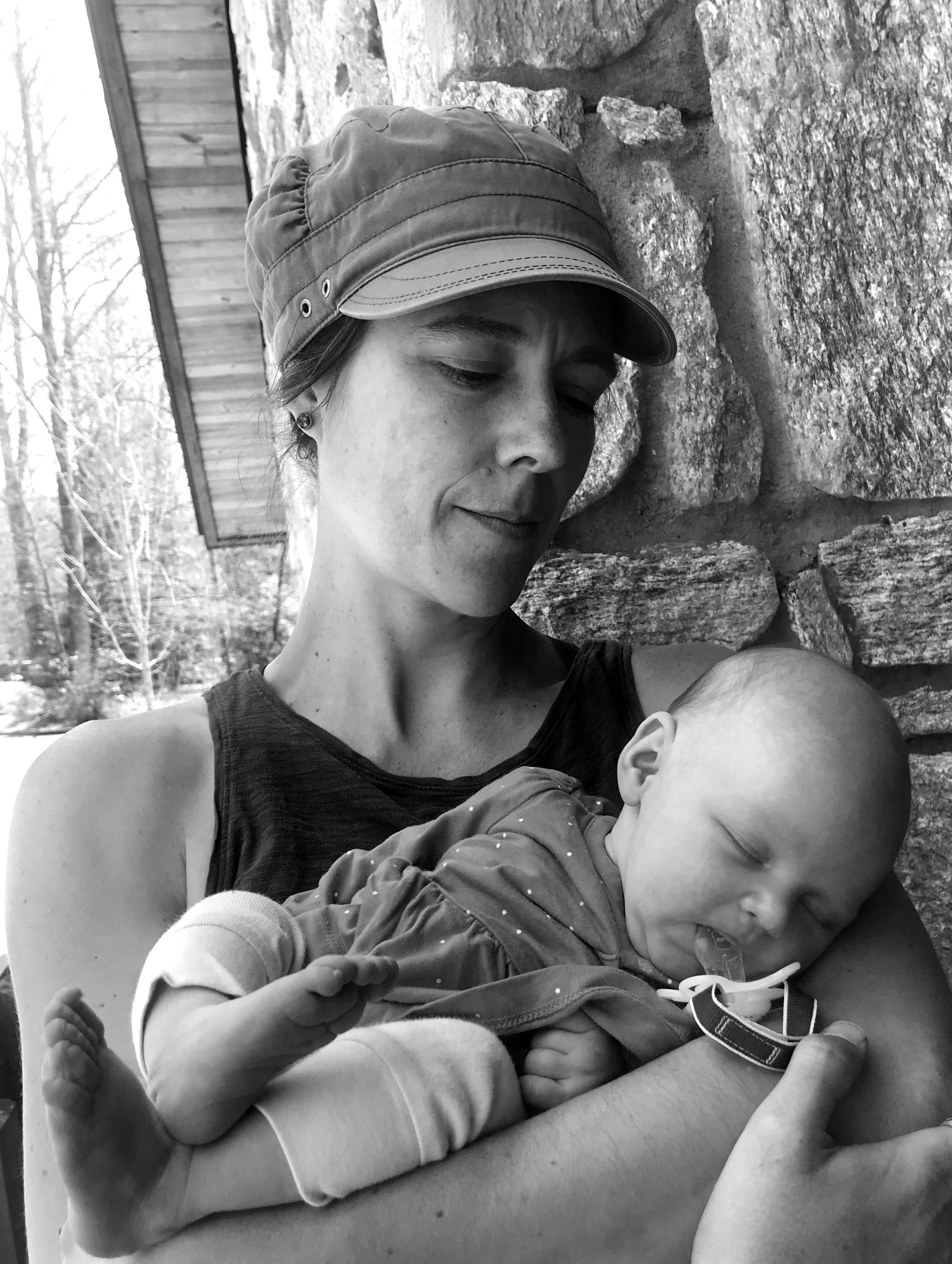
I gleaned that delicious phrase—”returning to joy”—from a slender volume picked up from a friend in the last three years. It has become a precious tool in my belt: Living from the Heart Jesus Gave You, by James G. Friesen, E. James Wilder, Anne Bierling, Rick Koepcke, and Maribeth Poole. It dovetails well with Paul’s famous “love chapter.”7 which focuses on love and leaving childish (selfish) ways behind him.
The practitioners at The Life Model produced their flagship book to point out how our expression of love must grow and develop through every life stage, maturing to increasingly emulate Christ’s love for his church.8 Their work connects me with “my why.9” Please note that it all begins with learning to receive love!
Here are a few thoughts from Living from the Heart Jesus Gave you to whet your appetite. They relate to the “task” of each life stage, slightly paraphrased to show them as learning objectives:
Infancy [birth to three years]:
Receive care/love
Childhood [three to 12 years old]:
Loving Care for self
Adulthood [13 to the birth of first child]:
Loving care for two people simultaneously
Parent [birth of first child until youngest child becomes an adult]:10
Sacrificial care for/love children
Elder [beginning when youngest child has become an adult]:11
Sacrificial care for/love community
As you can observe for yourself, each of these tasks centers around the idea of love and bonds created out of love. Loving bonds—created through a framework of sacrificial love from adults towards those in their care—facilitate our return to joy.
Read more on love bonds and the opposite in the following chart taken from the book:
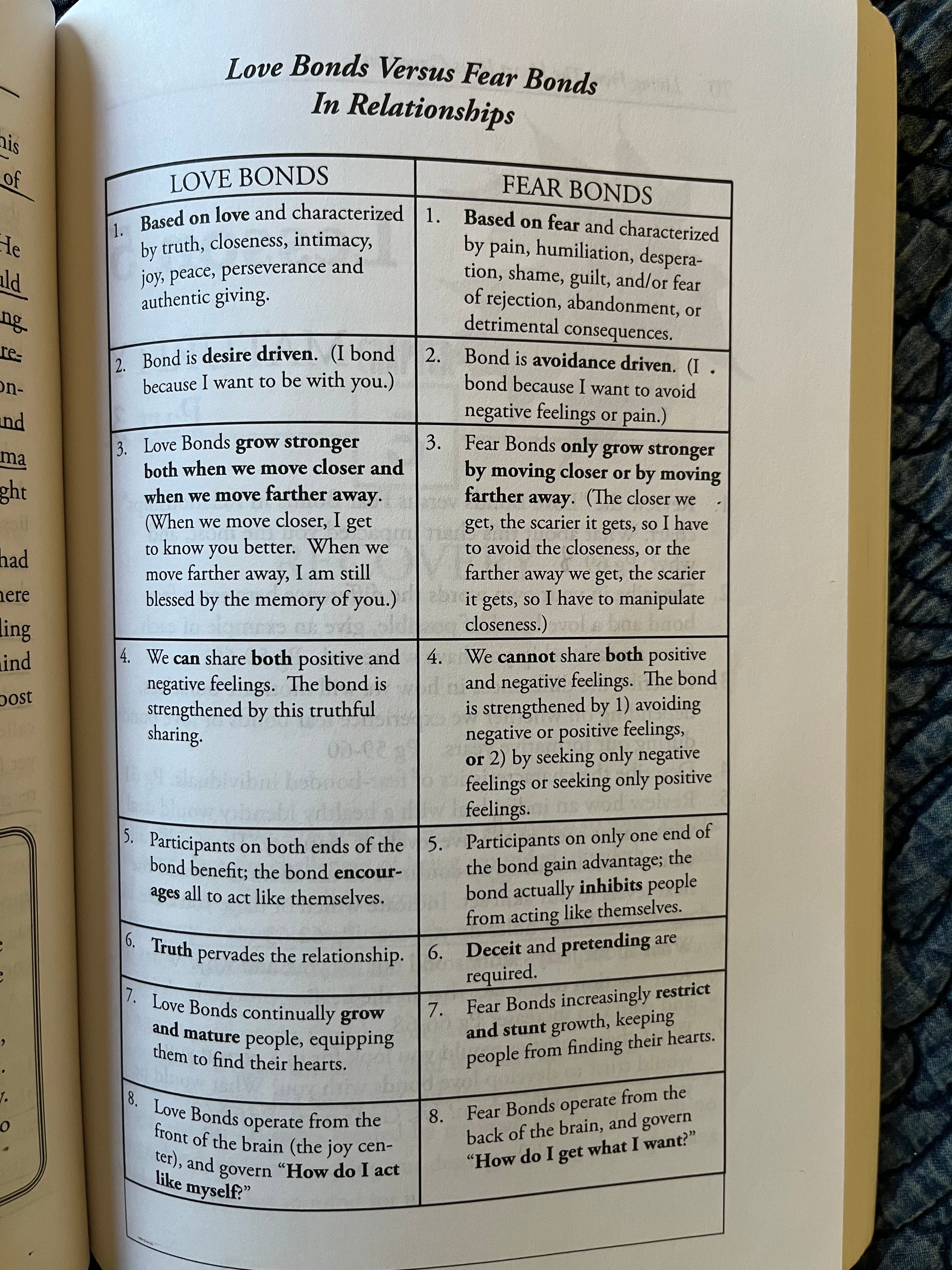
We start to realize the intrinsic, multi-faceted nature between sacrificial love and flourishing—and its opposite. Lets take a look at the primary resulting problems in if these developmental “tasks” are not completed in their time frame.12
Failure to learn to receive love - Weak and/or stormy relationships
Failure to learn to love yourself - Not taking responsibility for self/own actions
Failure to learn to love another - Lacks capacity to engage in mutually satisfying relationships
Failure to learn sacrificial love for children - Distant or conflicted family relationships
Failure to learn sacrificial love for community - The overall maturity of the community declines
Reading through the list of negative consequences, we easily trace broken patterns of relationship that unfold from other broken patterns of relationship, handed down from generation to generation—a downward spiral of brokenness and decay. As that realization dawns on you, you may experience the same gut-wrenching punch to the stomach as I: Oh dear God, have I ruined my kids? Is it too late to change? Or, equally as tummy-turning: How can I ever shed the sin patterns of generations?
Hopefully amidst the sickening feeling, you remember biblical passages that speak to these questions:
Exodus 20:5-6 says that God “visits the iniquity of fathers on children to the third and fourth generation” of those who hate him, but shows love to thousands who love him. This teaching forms in us the biblical perspective of Intergenerational Consequences - we pass on a heritage of sin and brokenness even as we pass on signs of the covenant and instruct our children in His ways.13
At the same time, Ezekiel 18:20 clarifies that “The son shall not bear the punishment for the sin of the father, nor shall the father bear the punishment for the sin of the son,” which informs our understanding of Individual Responsibility. Each of us stands as individuals before a holy and righteous God. We cannot blame shift our own brokenness and sin to others, we must face it (and its temporal consequences) and cling to the Savior who has taken the eternal consequences on himself.
We would lose all hope if we didn’t also meditate on the provision, breathed between the lines above. We see hope sparkling between the lines in Jesus’ reminders in John 9:1-3: “It was not that this man sinned, or his parents, but that the works of God might be displayed in him.”
This little sentence can radically alter our perspective. It not only reveals something of God’s sovereignty14 and faithfulness—he is at work in us!—but also provides the proper context—hope for man’s maturity tasks. Divine provision precedes human responsibility.15 Considering how many of the “indicatives” of the gospel seem to hit a-chronologically, let me remind you that God, who is outside of time/eternal, has always had a plan of redemptive provision in mind—therefore, it always precedes our obedience.
It’s like a sci-fi novel: The Eternal Being communicates his intentions for time-bound man in divine language that spans all possible tenses (past, present, progressive, future, future-past16…) yet somehow meaningfully shapes and reaches into time—mind blown? Mine sure is.
A couple of key points of clarification so we keep the “logic” in our theology:
Jesus words regarding the blind man and his parents do not mean that they were without sin (only Jesus can claim that).17
Just because God’s works are on display in us as in the blind man does not mean that we won’t experience the consequences of sin or the effects of the fall.
Though we have personal responsibility—and must “face up to our responsibilities” as we enter adulthood—that does not mean we are to blame for all the broken things we experience in our lives.
Though we have to take personal responsibility for our own lives and growth before God, that does not mean our parents don’t have some responsibility regarding how they raised us nor that we can wipe our hands of responsibility when our children become adults. (I refer you to the stage called “Elder” above).
All of these things and probably more are true of the devastating situation we find ourselves in a fallen (rebellious!) world.
Our situation without love is dire. But we have love—we have a reason for joy! We have the formula for a life filled with joy! We have the map back to joy for ourselves and our children: sacrificial love, equipped by his Spirit in us.
What does this all have to do with coloring pages? Well, if you haven’t figured it out yet: They are some of the breadcrumbs, the stepping stones, the pieces of childhood we need to remember (in case the map isn’t enough) for returning to and cultivating joy. I mean, just look! I mean really LOOK!
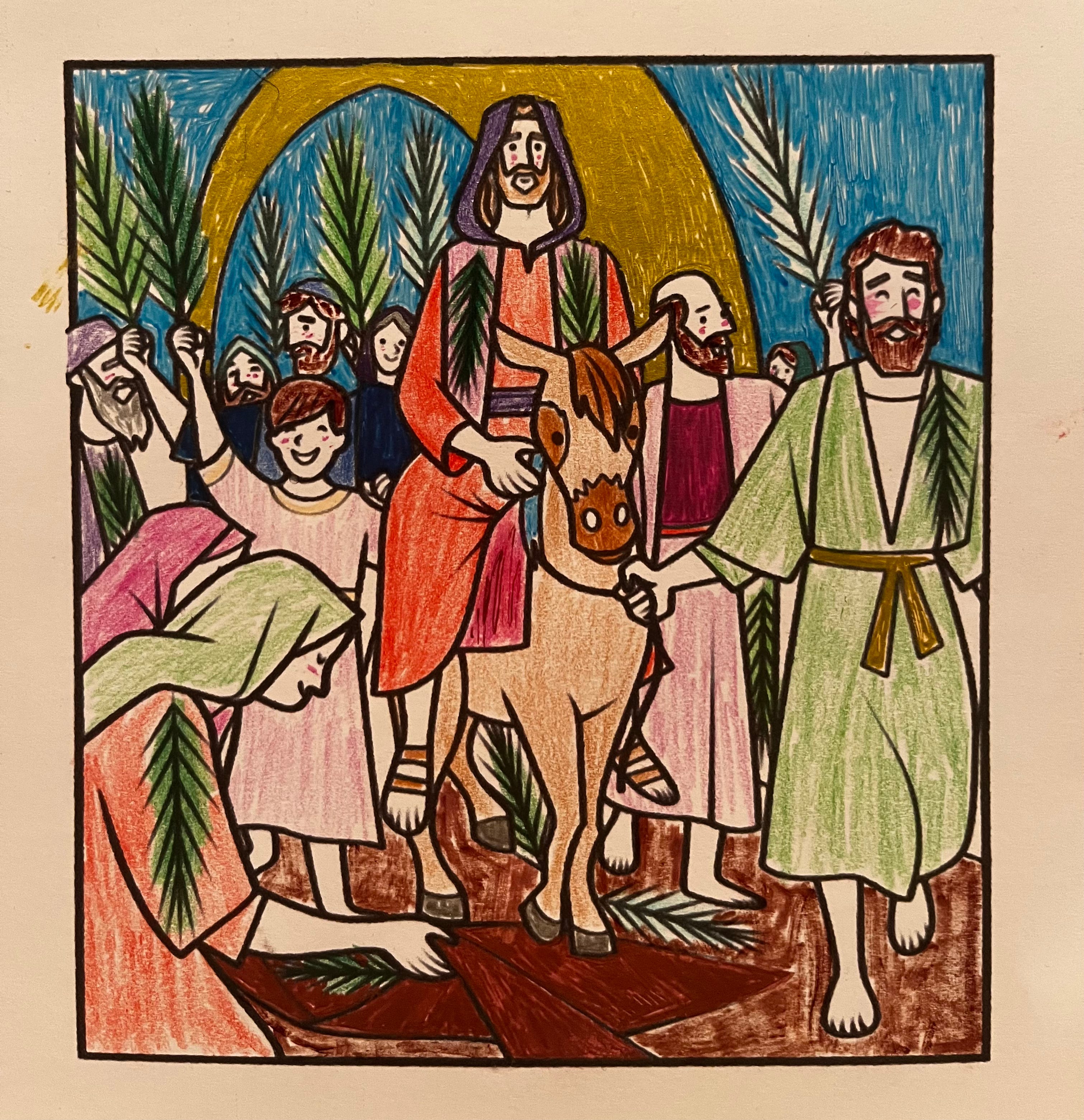
He came to us, humble, riding on a donkey, gentle, lowly, “For the joy set before him…”18 And he said “let the little children come to me and do not hinder them.” And he said “unless you become like this child you will not enter the kingdom of heaven.”
Even as we move forward into maturity, into the stages of sacrificial love, we have some reaching back to do in order to remember how to connect with and hold out our hands to the little ones the Lord allows us to serve. We need to remember to think “like a child” - not selfishly, but receptively, with honest hearts towards our own needy position before the Father.
May we embrace child-like dependence, making way for the Servant King to ride into our hearts; making loving, sacrificial way for the children coming behind us (“Greater love hath no man…”19. One hand placed in the hand of our Father; one hand to draw his little ones along with us, fostering and returning to JOY.
Questions to ask self:
What is the biggest obstacle in my life to “returning to joy”?
Who in my relational network (mentors, family members, church family) embodies the type of maturity and joy described above? Invite them out to coffee or have them over for tea and get to know them and allow them to get to know me!
As I look at the maturity tasks and the consequences of missing them, do I see any “failure to mature” patterns in my life? What kind of attention do those areas need so that I can continue on the journey towards maturity and ultimately contribute to others’ progress?
There are other members of humankind besides children for whom I can lay down self to love sacrificially: “the least, last, lost, lonely.” Where do I see them? How can I learn to love them better, by the power of the Spirit at work in me?
Sit and ponder that one for a while. It’ll kick perfectionism in the pants if anything can!
I probably should have named my Substack something like that. Oh well, I’m still finding my way…
see Psalm 90 - an all-time favorite.
And I realize I sound a lot like Veruca Salt. I do not want to be like her.
1 Corinthians 13:11
Tender apologies to those who have not entered or many never enter the parenting phase. Please do continue to read. Parenting might or might not be for you someday, but one way or another you have a chance to learn out to sacrifically love—you may want a hint of what’s to come for all of us—the Elder phase described briefly in the next section.
Check out their ministry here: https://lifemodelworks.org/
Though their theological tradition differs from the one on which my spiritual formation is based and their writing includes some material with which I need to wrestle further, the majority of their content challenges me towards growth and deepens my understanding of the discipleship process and its dimension. More to affirm than to challenge here.
Thank you, Simon Sinek.
This developmental task can be achieved on some level through learning how to care for children that are not your own progeny.
I have witnessed many older, single adults and childless couples strive toward this developmental task and beautifully reach it - SDG
Important distinction: My understanding is that the negative repercussions listed derive from never meeting the stage’s objective—an individual may find themselves stuck in a regressive relational pattern until that task is (eventually) accomplished—but that the best stage for this learning is as detailed. Consider attachment theory and how an infant develops a secure attachment (or an alternative) dependent upon the sacrificial care/love/attention given by his mother. However: There is always hope that “miseducation” or “underdevelopment” can be remedied (or mitigated) by the grace we have in Christ Jesus and by the power of His Spirit.
Deuteronomy 6
Need more convincing? See the book of Job (my equivalent of a mic drop).
Or “the indicatives of the gospel fuel and equip the imperatives of the Christian life.”
Future/past? What are you talking about?
The prophetic aorist (or *proleptic aorist) is a specialized Greek tense usage where a past-tense verb form describes a future event, emphasizing that the event is so certain to happen it is viewed as already accomplished. While the aorist typically denotes a completed action in the past, in prophetic contexts, it emphasizes divine certainty.
Hebrews 4:15
Hebrews 12:2
John 15:13